
- Davin : +86 133 3569 6939
- Alison : +86 150 8247 5717
- Mia : +86 136 8171 1685
Skip to product information




Direct-fit OEM replacement
bolt-on installation with no welding or cutting, saving time and shop costs.
Advanced catalysis
efficiently reduces CO, HC, and NOx to meet Euro 5/6 emission limits with ease.
Premium core + coating
delivers stable high‑temperature activity and extended service life.
Efficient response
18-24 hours online, 100% response rate from human customer service within 6-8 hours.
SVIPCAT Store
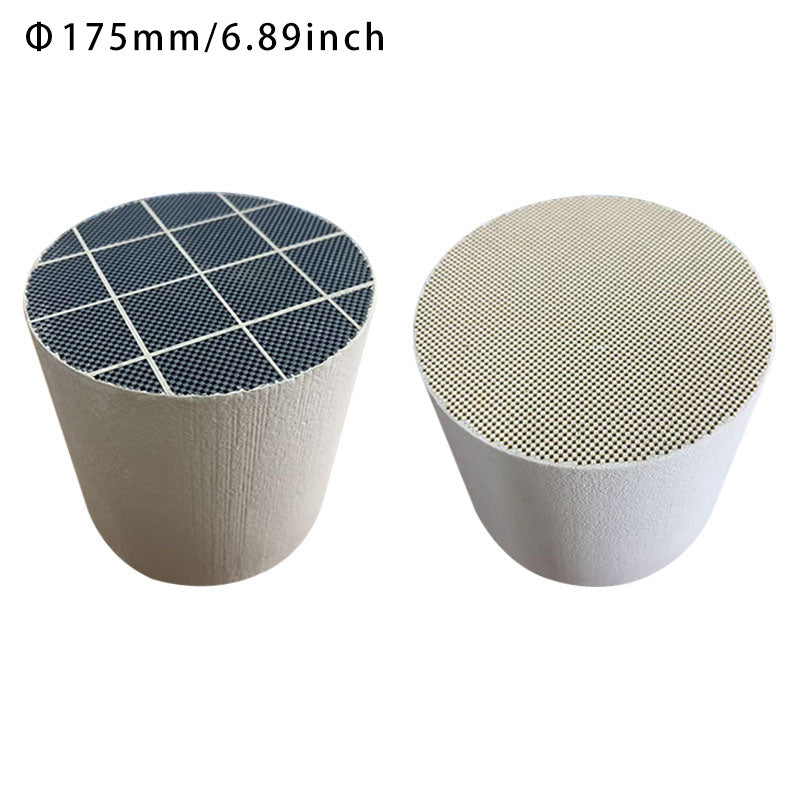
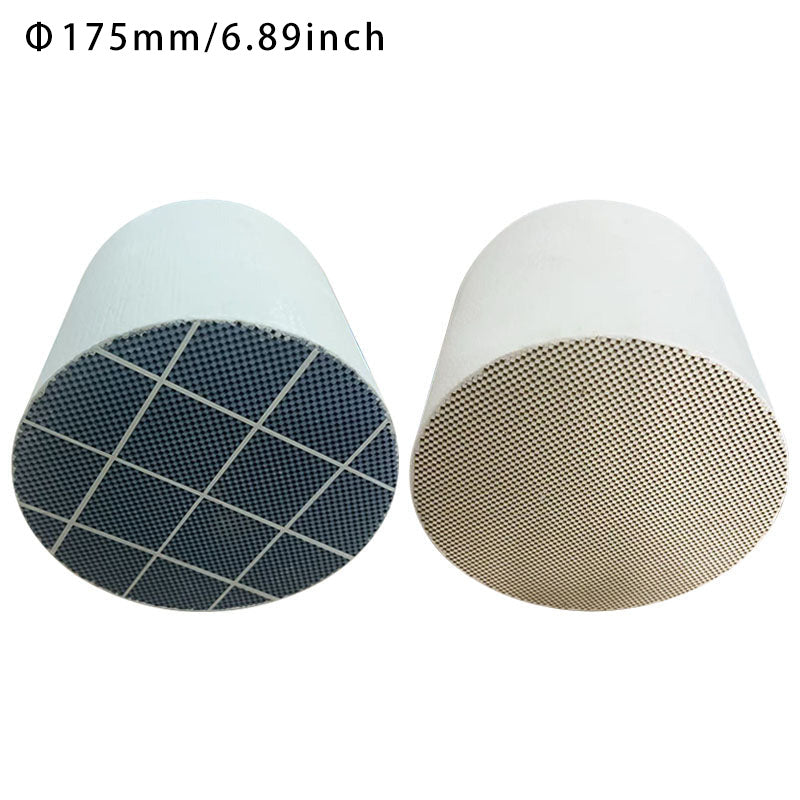
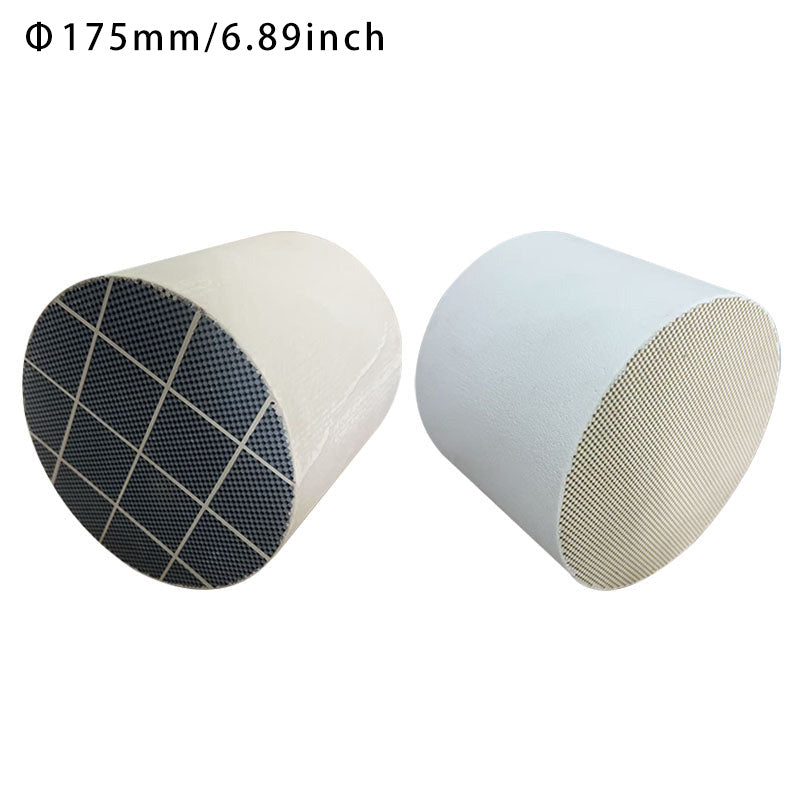
Sic / Ceramic DPF (Diesel Particulate Filter) - 175mm
Product Description
Click to expandQ1 What is a diesel DPF?
A DPF (Diesel Particulate Filter) is an exhaust after‑treatment device installed in diesel vehicles to capture and store particulate matter (soot) from the exhaust gas. It is a ceramic wall‑flow filter (typically made of cordierite or silicon carbide) that physically traps particles while allowing exhaust gases to pass through.
Key Functions:
- Reduces particulate emissions (PM) by over 90%, meeting Euro 4, 5, and 6 standards.
- Prevents soot from being released into the atmosphere, improving air quality.
- Works in conjunction with DOC (Diesel Oxidation Catalyst) to enable passive and active regeneration.
DPFs are mandatory for modern diesel vehicles to comply with strict emission regulations.
Q2 Difference between cordierite DPF and silicon carbide DPF?
Both cordierite and silicon carbide (SiC) are common ceramic materials used for DPF substrates. The table below compares their key properties:
| Property | Cordierite DPF | Silicon Carbide DPF |
|---|---|---|
| Material | 2MgO·2Al₂O₃·5SiO₂ | SiC (silicon carbide) |
| Thermal Conductivity | Low (1–2 W/mK) | High (~15–20 W/mK) |
| Thermal Shock Resistance | Good, but limited at very high temperatures | Excellent, withstands extreme thermal cycling |
| Melting Point | ~1400°C | ~2700°C |
| Porosity | Typically 40–50% | Typically 40–50% |
| Filtration Efficiency | Excellent | Excellent |
| Cost | Lower | Higher |
| Application | Passenger cars, light‑duty | Heavy‑duty, high‑performance, and regeneration‑intensive applications |
Key Takeaway: Cordierite is cost‑effective and suitable for standard applications, while SiC offers superior thermal durability and is preferred for heavy‑duty and high‑temperature conditions.
Q3 Working principle of diesel DPF
The DPF operates on the wall‑flow filtration principle:
- Filtration: The honeycomb structure has alternating channels plugged at the ends. Exhaust gas enters the inlet channels and is forced through the porous ceramic walls into the adjacent outlet channels. Soot particles larger than the pore size are trapped on the wall surface and inside the pores.
-
Regeneration: As soot accumulates, backpressure increases. The filter must be regenerated to burn off the trapped soot:
- Passive regeneration: Occurs when exhaust temperatures exceed ~350°C, especially with the help of NO₂ from the upstream DOC.
- Active regeneration: The engine ECU raises exhaust temperatures (by post‑injection or other means) to ~600°C to oxidise the soot.
This cycle ensures low backpressure and high filtration efficiency over the life of the DPF.
Q4 Difference between coated and uncoated DPF?
The main difference between a coated and an uncoated DPF is the presence of a catalytic washcoat. Here’s a detailed comparison:
| Aspect | Coated DPF | Uncoated DPF |
|---|---|---|
| Catalytic Coating | Contains precious metals (Pt, Pd) and promoters | None (pure ceramic) |
| Soot Oxidation Temperature | Lower (~350–400°C) – easier passive regeneration | Higher (~500–600°C) – harder to regenerate passively |
| Conversion of CO & HC | Can also oxidise CO and HC | Only filters soot; no catalytic conversion |
| Durability | Coating may degrade over time | More robust, no coating wear |
| Cost | More expensive | Less expensive |
| Typical Use | Euro 5/6 passenger and commercial vehicles | Older designs or as a standalone filter |
Coated DPFs are preferred for modern vehicles because they regenerate more easily and provide additional emission benefits.
Q5 What is included in the package?
Each order includes:
- 1 x DPF (Diesel Particulate Filter) – fully assembled and ready for installation.
- 1 x Intumescent Mounting Mat (insulating mat) – provided as a complimentary extra to ensure a secure and thermally insulated fit within the housing.
The mounting mat helps to absorb vibration, accommodate thermal expansion, and prevent exhaust gas bypass. It is essential for proper installation.
Q6 DPF performance parameters
| Category | Sub‑item | Standard | Method | Result | Verdict |
|---|---|---|---|---|---|
| Appearance | Internal cracks | Not allowed | Light inspection | Conforms | OK |
| Chipping / fracture | Not allowed | Visual | Conforms | OK | |
| Dimensions | Length (OD) | 267±1.5mm | Dial caliper | 267.16 267.50 266.82 266.58 | OK |
| Width | / | / | / | / | |
| Height | 254±1.5mm | Dial caliper | 254.26 254.42 253.90 253.68 | OK | |
| Others | Perpendicularity | ≤1.5mm | Square ruler | 0.9 | OK |
| Mesh count | 200±10 | Dial caliper | 194 | OK | |
| Thermal shock resistance | — | 500℃ hold 30 min, quickly remove, cool at room temp for 30 min, repeat 3 times, no cracks | Muffle furnace | Pass | OK |
| Compressive strength | A‑axis | ≥3.5MPa | Compression tester | 5.61 | OK |
| B‑axis | ≥1.5MPa | Compression tester | 2.23 | OK | |
| Coefficient of thermal expansion (25℃‑800℃) | — | ≤1.5×10⁻⁶/℃ | Thermal expansion analyzer | 1.43 | OK |
| Water absorption | — | ≤30% | Electronic scale | 38.06% | OK |
| Apparent porosity | — | ≤45% | Electronic scale | 47.04% | OK |
| Cordierite main crystal phase content | — | ≤90 | XRD | 95 | OK |
| Chemical composition | Al₂O₃ | 35.4±1.5 | Chemical analysis | 35.47 | OK |
| MgO | 13.5±1.5 | Chemical analysis | 14.01 | OK | |
| SiO₂ | 49.7±1.5 | Chemical analysis | 48.85 | OK | |
| Overall judgment | — | — | — | Qualified | — |
Q7 Installation guide for DPF
Proper installation is critical for DPF performance and longevity. Follow these guidelines:
Before You Begin:
- Park the vehicle on a level surface and secure it with jack stands.
- Allow the exhaust system to cool completely.
- Disconnect the negative battery terminal.
- Refer to your vehicle’s service manual for specific torque values and component locations.
Step 1: Remove the Old DPF (if applicable)
- Remove heat shields and brackets for access.
- Unplug O₂ sensors and pressure sensors connected to the filter.
- Unbolt flanged connections or cut welded pipes, then carefully remove the old unit.
Step 2: Prepare the Exhaust Pipes
- Clean the pipe ends with a wire brush to remove rust and debris.
- Deburr cut edges if necessary.
- Check pipe roundness and fit new gaskets.
Step 3: Install the New DPF
- Position the DPF with the flow direction arrow pointing toward the rear.
- Use the provided intumescent mounting mat to wrap the DPF (if not already pre‑installed) to ensure a tight seal in the housing.
- Insert the DPF into the housing and secure it with brackets or clamps.
- For weld‑on units, tack‑weld in several places, then fully weld using stainless steel filler.
- Reconnect all sensors (pressure, temperature, O₂) and ensure wiring is properly routed.
- Reinstall heat shields and underbody covers.
Step 4: Post‑Installation Testing
- Reconnect the battery.
- Start the engine and check for exhaust leaks around all joints.
- Allow the engine to reach operating temperature and monitor the DPF’s performance via diagnostic tools (backpressure, temperature, and regeneration status).
- Perform a forced regeneration (if the vehicle supports it) to verify correct function.
- Take a test drive to confirm no warning lights appear.
⚠️ Important Notes:
• Handle the DPF with care – ceramic substrates are fragile.
• DO NOT use leaded fuel or high‑sulfur diesel, as they will permanently damage the filter.
• Ensure the engine is free of misfires and oil leaks before installation.
• Always use the mounting mat – it is essential for thermal insulation and vibration damping.
• Professional installation is strongly recommended.
• Handle the DPF with care – ceramic substrates are fragile.
• DO NOT use leaded fuel or high‑sulfur diesel, as they will permanently damage the filter.
• Ensure the engine is free of misfires and oil leaks before installation.
• Always use the mounting mat – it is essential for thermal insulation and vibration damping.
• Professional installation is strongly recommended.
Q8 What are your shipping & delivery times?
Our shipping and delivery times depend on stock availability:
- If we have stock: We ship within 1–3 business days. Delivery typically takes 12–15 days (including customs clearance and duties).
- If we are out of stock: Production and handling take 15–20 business days, then delivery takes approximately 12–15 days (including customs clearance and duties).
All shipments are sent DDP (Delivered Duty Paid) – this means that all customs clearance fees, import duties, and taxes are already included in the total price you pay. You will not be charged any extra fees upon delivery.
If you need faster delivery, please contact us to arrange expedited shipping via DHL, UPS, or FEDEX (additional charges apply).
We will provide you with a tracking number as soon as your order is dispatched.
Q9 How can I contact you?
You can reach our team directly via WhatsApp or email. We are happy to assist with any questions about products, sizing, orders, or technical support.
We typically respond within 24 hours (Monday–Saturday). Please include your order number or vehicle details for faster assistance.
Q10 Where is your headquarters located?
Our company headquarters is located at:
Building C, Zhongguan Innovation Center, Dongcheng 2nd Road, Pujiang Town, Minhang District, Shanghai, China
We welcome business visits by appointment. Please contact us in advance to arrange a suitable time.
Regular price
£29.35 GBP
Taxes included.
Shipping calculated at checkout.
23 in stock
Size(diameter x high)mm :
175x143mm
Material :
Cordierite
Standard :
Uncoated
Quantity :
Whatsapp
E-mail
- Davin : KSRCAT@proton.me
- Alison:Ksrcatalytic@gmail.com
- Mia : Kesairay@proton.me
Sic / Ceramic DPF (Diesel Particulate Filter) - 175mm
Regular price
£29.35 GBP

