
- Davin : +86 133 3569 6939
- Alison : +86 150 8247 5717
- Mia : +86 136 8171 1685
Skip to product information




Direct-fit OEM replacement
bolt-on installation with no welding or cutting, saving time and shop costs.
Advanced catalysis
efficiently reduces CO, HC, and NOx to meet Euro 5/6 emission limits with ease.
Premium core + coating
delivers stable high‑temperature activity and extended service life.
Efficient response
18-24 hours online, 100% response rate from human customer service within 6-8 hours.
SVIPCAT Store
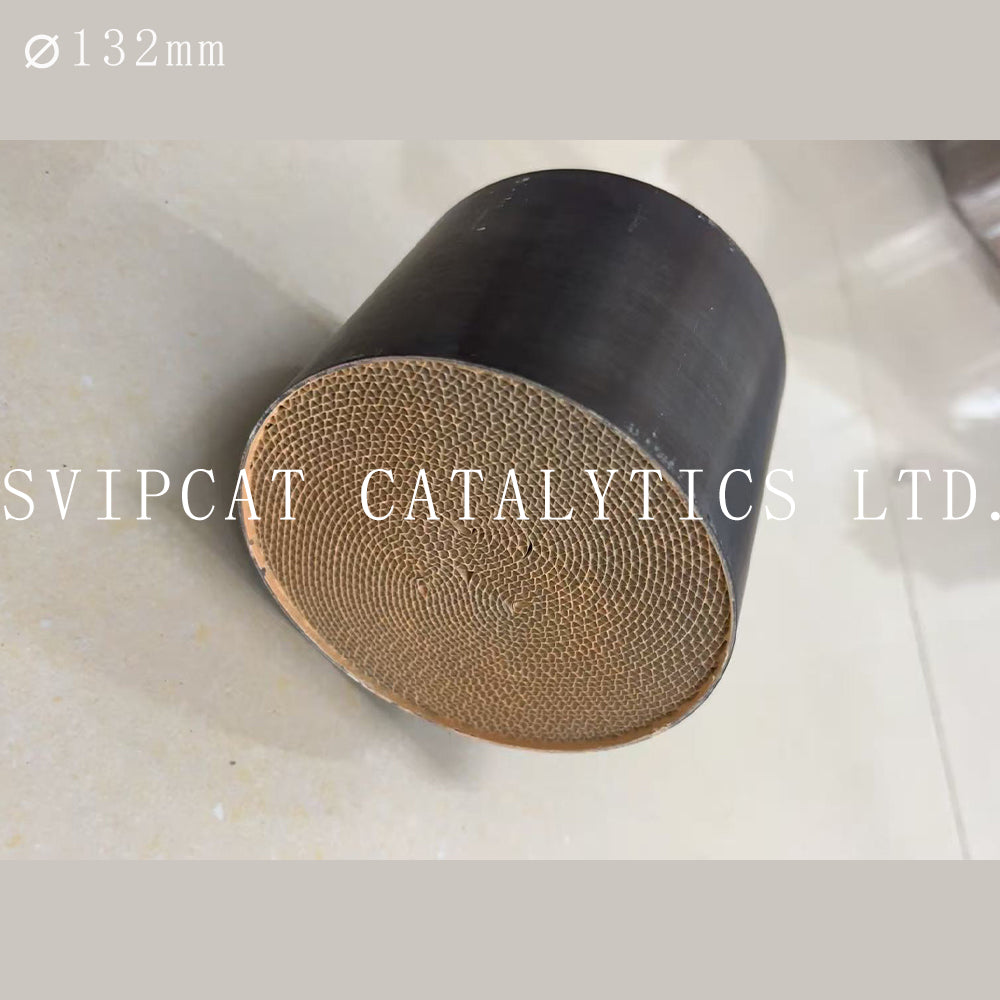
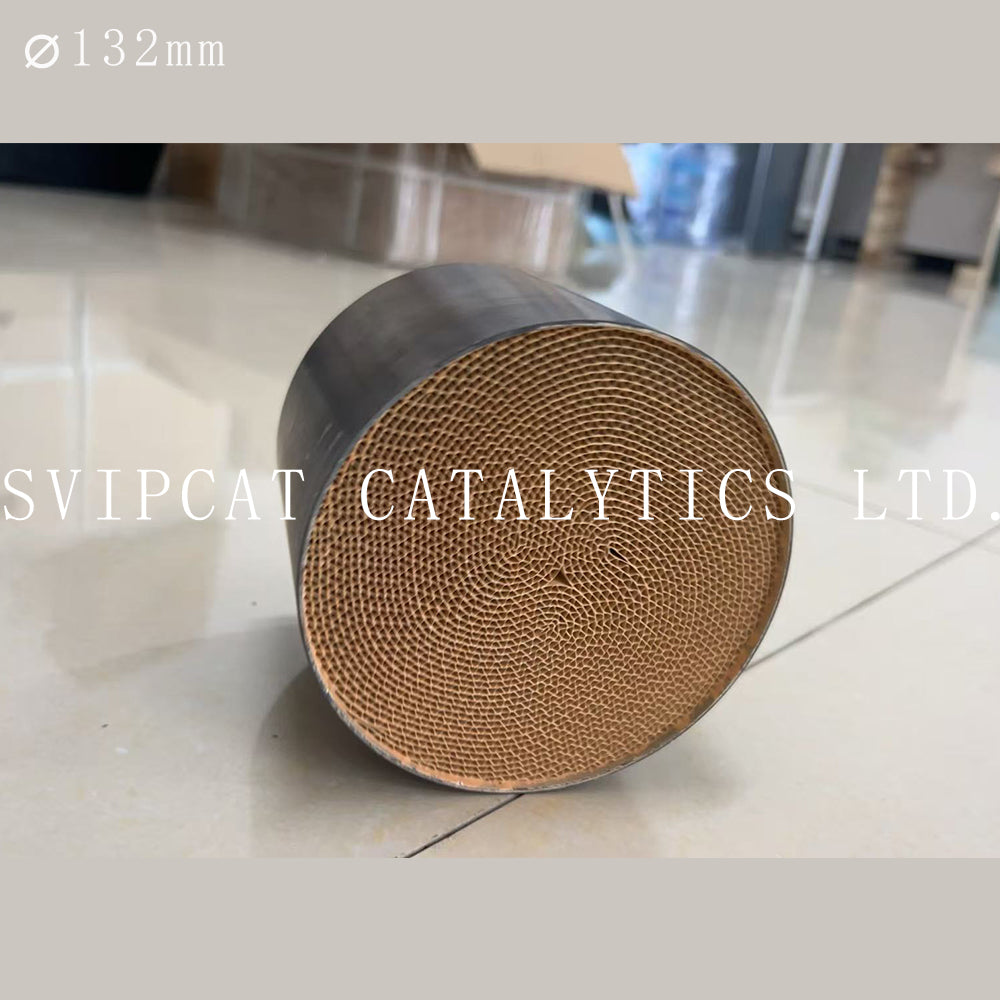
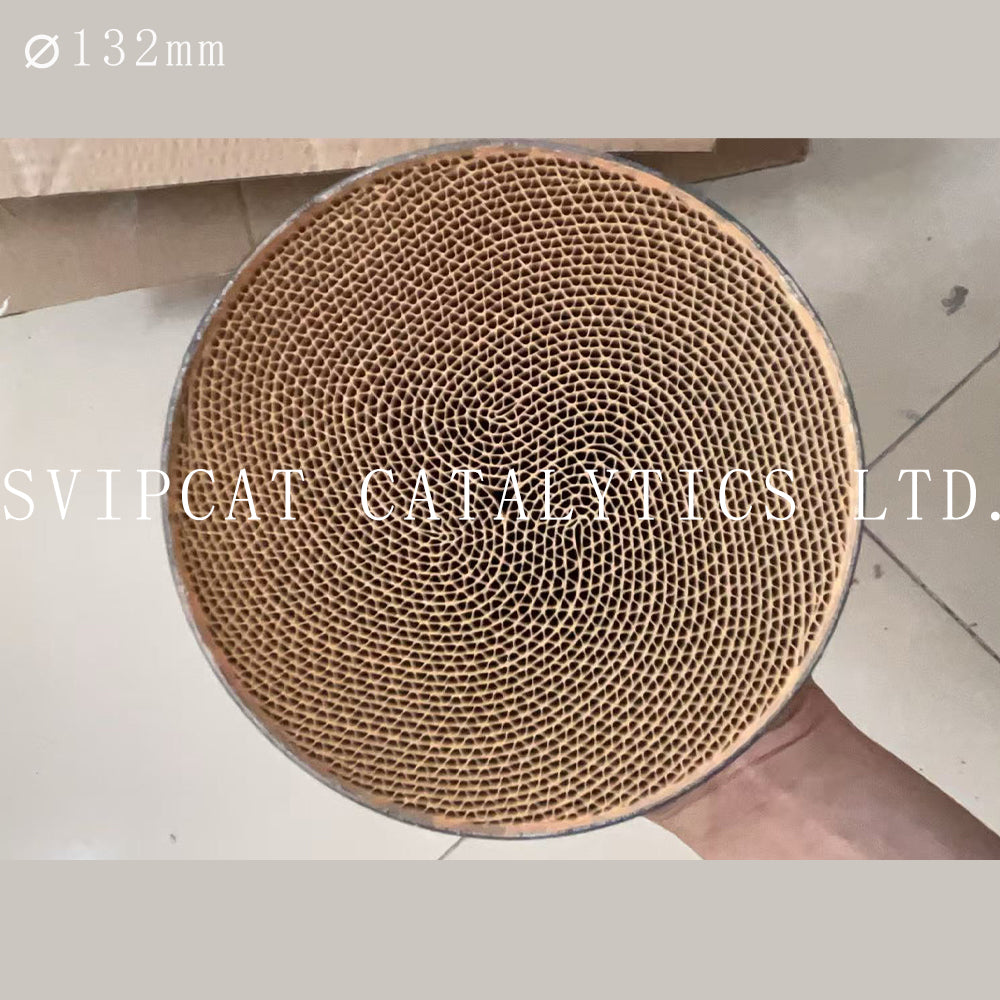
132mm Metal high-performance catalytic converter
Product Description
Click to expandQ1 Metal substrate material specifications
Metal honeycomb substrates are manufactured in nearly 10,000 specifications and support full non‑standard customization.
- Housing materials: 316L, 304, 444, 441 (or customer‑specified).
- Core material: FeCr21Al6 (ferritic stainless steel).
- Carrier outer diameter: 12 – 960 mm.
- Height: 9 – 150 mm.
- Cell density (CPSI): 5 – 1200 cpsi.
- Shell wall thickness: 0.5 – 3.0 mm (shell‑less option available).
- Core wall thickness: 0.03 – 0.18 mm.
- Internal core configuration: single core, S‑core, or three‑core.
- Available shapes: cylindrical, rectangular, square, racetrack (oval), elliptical, trapezoidal, pentagonal, pear‑shaped.
These substrates offer extreme design flexibility to match virtually any exhaust system requirement.
Q2 Working Principle of Catalytic Converter
A three-way catalytic converter (TWC) simultaneously converts three primary harmful exhaust pollutants into less harmful substances through oxidation and reduction reactions:
- Carbon Monoxide (CO) → oxidized into Carbon Dioxide (CO₂)
- Unburned Hydrocarbons (HC) → oxidized into Carbon Dioxide (CO₂) and Water (H₂O)
- Nitrogen Oxides (NOx) → reduced into Nitrogen (N₂) and Oxygen (O₂)
The substrate (ceramic or metal) is coated with a "washcoat" containing precious metal catalysts (platinum, palladium, rhodium). As exhaust gases pass through the honeycomb channels at high temperature (around 300°C), these metals catalyze the chemical reactions that convert approximately 98% of harmful emissions into harmless gases. This process is essential for meeting global emissions standards and protecting air quality.
Q3 What is a high-flow catalytic converter?
A high-flow catalytic converter (also known as a high-performance or sports catalytic converter) is an aftermarket emissions device designed to reduce exhaust backpressure while still providing catalytic conversion. It achieves this by using a substrate with lower cell density (e.g., 200–300 CPSI) and/or larger channel diameters compared to standard OEM converters (typically 400–600 CPSI). This allows exhaust gases to pass through more freely, which can lead to modest horsepower gains and improved throttle response.
Key Features:
- Lower cell density – fewer cells per square inch reduce restriction.
- Thinner walls – reduce weight and thermal mass, allowing faster warm‑up.
- Metallic or ceramic substrates – available in both materials, with metal being more common for performance.
- Often used with modified engines – turbocharged, supercharged, or high‑performance naturally aspirated engines.
Advantages:
- Reduced exhaust backpressure → potential power gains (typically 5–15 HP).
- Quicker turbo spool and improved mid‑range torque.
- Lighter weight compared to some OEM converters.
- Can be paired with ECU tuning for optimized performance.
Disadvantages / Considerations:
- Lower conversion efficiency – especially at high space velocities, may not meet strict emission standards (Euro 3‑6) in all conditions.
- Potential check‑engine light – may trigger O₂ sensor codes if the catalyst efficiency drops below the ECU's threshold (requires tuning or O₂ sensor spacers).
- Not legal for street use in many regions – check local regulations before installing on a road‑going vehicle.
- May increase exhaust noise – due to reduced restriction.
High‑flow catalytic converters are best suited for track‑only vehicles or properly tuned street cars where emissions compliance is not a primary concern.
Q4 Warranty policy for high-flow catalytic converters
This product is sold without any warranty, either express or implied.
High‑flow catalytic converters are performance‑oriented parts designed for modified vehicles and off‑road applications. The following reasons explain why we do not offer a warranty on these items:
- Aftermarket performance nature – these converters are not OEM‑equivalent and are intended for use in conjunction with engine modifications (e.g., forced induction, ECU tuning, fuel system upgrades) that significantly affect emissions and exhaust gas composition.
- Installation variability – improper welding, incorrect positioning, or use of incompatible exhaust systems can damage the substrate or reduce its effectiveness.
- Engine condition – pre‑existing engine issues (such as misfires, oil consumption, or running rich/lean) can lead to premature catalyst degradation, which is not a manufacturing defect.
- Fuel quality – use of leaded fuel or low‑quality fuel containing excessive sulfur or contaminants can poison the catalyst.
- Overheating – high‑flow converters are more sensitive to extreme temperatures; inadequate heat shielding or prolonged high‑load operation can cause melting or cracking.
- Legal compliance – these converters may not meet emissions standards in some regions; any use that results in inspection failure or fines is the sole responsibility of the buyer.
By purchasing this high-flow catalytic converter, you acknowledge that:
- You are responsible for verifying compatibility with your vehicle and local laws.
- Installation, tuning, and maintenance are performed at your own risk.
- We do not accept returns or offer refunds for performance‑related products once they have been installed or used.
If you have any questions regarding fitment or tuning, please contact our support team before purchasing.
Q5 Installation guide for metal catalytic converters
This guide covers the general installation procedure for metal substrate catalytic converters (both universal and shell‑type units). Professional installation by a qualified exhaust technician is strongly recommended.
⚠️ Before You Begin:
- Park the vehicle on a level, solid surface and use jack stands.
- Allow the exhaust system to cool completely – catalytic converters retain heat for a long time.
- Disconnect the negative battery terminal.
- Apply penetrating oil to all bolts and nuts at least a few hours in advance.
- Consult your vehicle's service manual for specific torque values and component locations.
Step 1: Remove the Old Catalytic Converter
- Raise the vehicle and secure it safely.
- Remove heat shields, braces, or underbody covers that block access.
- Unplug the upstream and downstream oxygen sensors (O₂ sensors) and carefully unscrew them from the old converter.
- Unbolt the flanged connections at the inlet and outlet. If the converter is welded, cut the pipes at the appropriate points using a reciprocating saw or exhaust pipe cutter.
- Remove the old converter assembly from the vehicle.
Step 2: Prepare the Exhaust Pipes
- Clean the pipe ends thoroughly with a wire brush to remove rust, carbon, and old gasket material.
- If cut, deburr the edges to ensure a smooth surface.
- Check the pipe diameter and roundness; use an expander if needed.
- Fit new gaskets on both flanges (never reuse old gaskets).
Step 3: Position and Install the New Metal Converter
- Place the new converter in the exhaust system, ensuring the flow direction arrow points toward the rear of the vehicle.
- Align the inlet and outlet pipes with the flanges or cut ends.
- For bolt‑on converters:
- Insert new bolts and nuts, apply high‑temperature anti‑seize, and torque to the manufacturer's specification (usually 30–45 Nm).
- Tighten in a cross‑pattern to avoid warping.
- For weld‑on converters:
- Tack‑weld in several places to hold position.
- Verify alignment and weld fully around both joints using stainless steel wire (for stainless exhausts).
- Allow the welds to cool slowly.
- For clamp‑on connections, slide the clamp over the joint and tighten to the recommended torque.
Step 4: Reinstall Oxygen Sensors and Other Components
- Apply a small amount of anti‑seize to the sensor threads (avoid the sensor tip).
- Screw the O₂ sensors into their bungs on the new converter and torque to 30–45 Nm.
- Reconnect the sensor wiring securely and route it away from heat sources.
- Reinstall all heat shields, brackets, and underbody covers removed earlier.
Step 5: Test the Installation
- Reconnect the battery.
- Start the engine and let it idle.
- Check for exhaust leaks around all joints (listen for hissing, feel for escaping gases, or use soapy water spray).
- Allow the engine to reach normal operating temperature (the converter needs ~300°C to begin working).
- Verify that the check engine light does not appear. If it does, use an OBD‑II scanner to read codes; common issues include O₂ sensor problems or catalyst inefficiency.
- Take a 10‑15 minute test drive and re‑inspect all connections after the system has cooled.
⚠️ Important Notes:
• Metal substrates can be damaged by excessive heat – ensure proper fuel mixture and ignition timing to avoid meltdown.
• Always use the correct type of converter for your engine size and power output.
• For high‑flow performance converters, ECU tuning may be required to prevent error codes.
• In some areas, replacing a converter with a non‑OEM unit may be illegal – check local emissions laws beforehand.
• If you are not experienced with exhaust system work, we strongly recommend using a professional shop.
• Metal substrates can be damaged by excessive heat – ensure proper fuel mixture and ignition timing to avoid meltdown.
• Always use the correct type of converter for your engine size and power output.
• For high‑flow performance converters, ECU tuning may be required to prevent error codes.
• In some areas, replacing a converter with a non‑OEM unit may be illegal – check local emissions laws beforehand.
• If you are not experienced with exhaust system work, we strongly recommend using a professional shop.
Q6 What are your shipping & delivery times?
Our shipping and delivery times depend on stock availability:
- If we have stock: We ship within 1–3 business days. Delivery typically takes 12–15 days (including customs clearance and duties).
- If we are out of stock: Production and handling take 15–20 business days, then delivery takes approximately 12–15 days (including customs clearance and duties).
All shipments are sent DDP (Delivered Duty Paid) – this means that all customs clearance fees, import duties, and taxes are already included in the total price you pay. You will not be charged any extra fees upon delivery.
If you need faster delivery, please contact us to arrange expedited shipping via DHL, UPS, or FEDEX (additional charges apply).
We will provide you with a tracking number as soon as your order is dispatched.
Q7 How can I contact you?
You can reach our team directly via WhatsApp or email. We are happy to assist with any questions about products, sizing, orders, or technical support.
We typically respond within 24 hours (Monday–Saturday). Please include your order number or vehicle details for faster assistance.
Q8 Where is your headquarters located?
Our company headquarters is located at:
Building C, Zhongguan Innovation Center, Dongcheng 2nd Road, Pujiang Town, Minhang District, Shanghai, China
We welcome business visits by appointment. Please contact us in advance to arrange a suitable time.
Regular price
£177.81 GBP
Taxes included.
Shipping calculated at checkout.
99 in stock
Size(diameter x height)mm :
132x100mm
Cpsi :
200
Quantity :
Whatsapp
E-mail
- Davin : KSRCAT@proton.me
- Alison:Ksrcatalytic@gmail.com
- Mia : Kesairay@proton.me
132mm Metal high-performance catalytic converter
Regular price
£177.81 GBP

