
- Davin : +86 133 3569 6939
- Alison : +86 150 8247 5717
- Mia : +86 136 8171 1685
Skip to product information




Direct-fit OEM replacement
bolt-on installation with no welding or cutting, saving time and shop costs.
Advanced catalysis
efficiently reduces CO, HC, and NOx to meet Euro 5/6 emission limits with ease.
Premium core + coating
delivers stable high‑temperature activity and extended service life.
Efficient response
18-24 hours online, 100% response rate from human customer service within 6-8 hours.
SVIPCAT Store
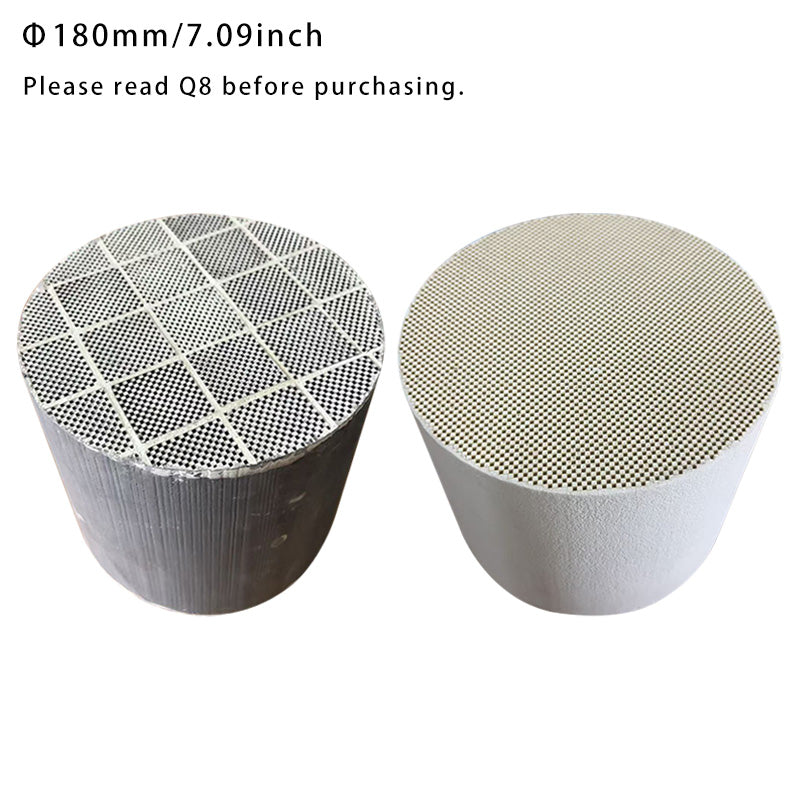
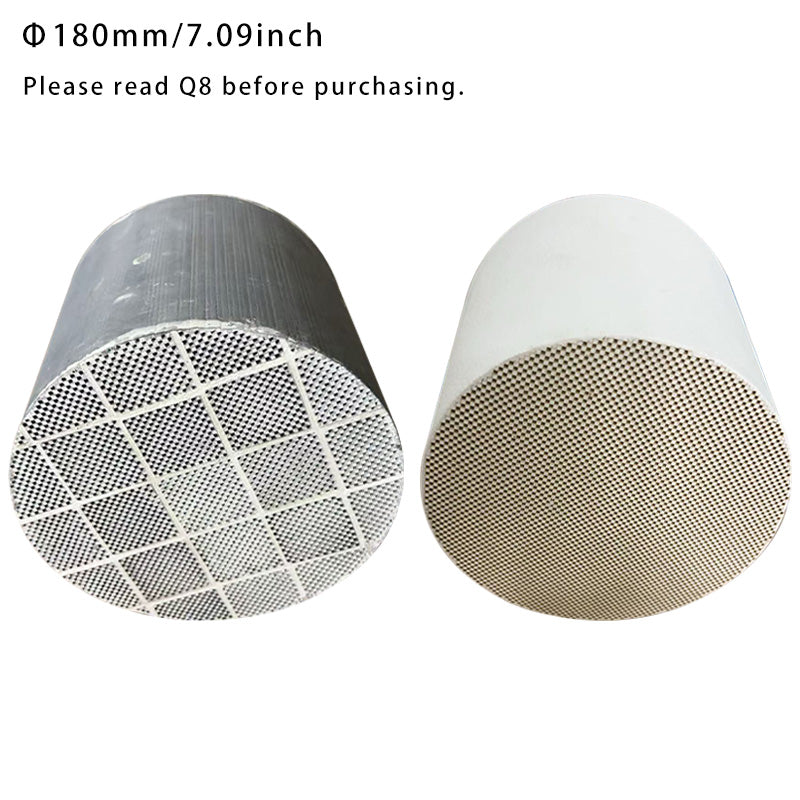
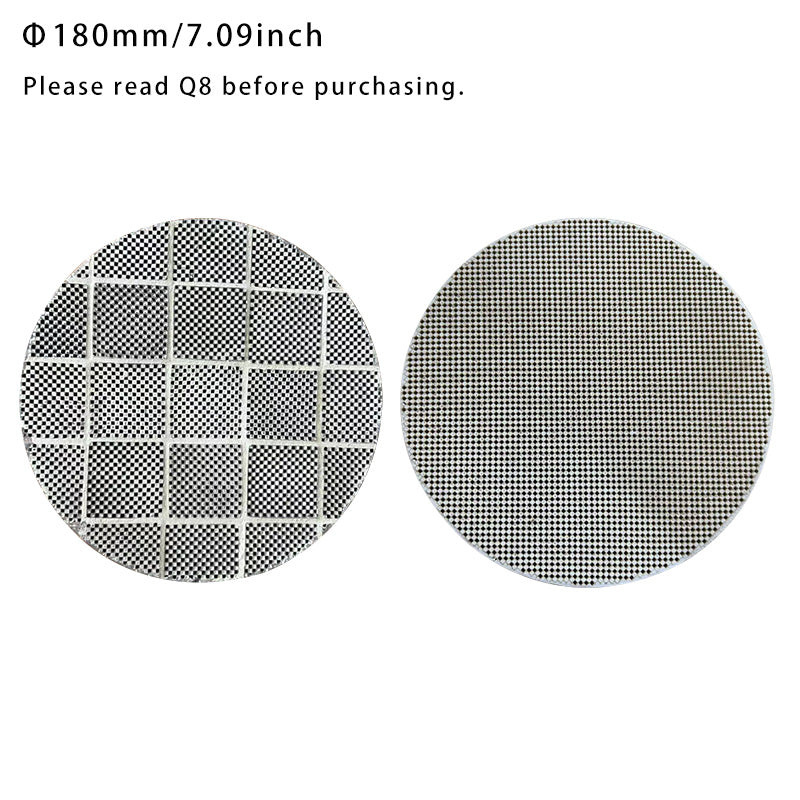
DPF/SCRF SiC Ceramic Diesel Particulate Filter 180mm (7.09")
Product Description
Click to expandQ1 What is SDPF / SCRF?
SDPF (Selective Catalytic Reduction Filter) or SCRF (SCR on Filter) is an integrated after‑treatment device that combines a DPF (Diesel Particulate Filter) with an SCR (Selective Catalytic Reduction) catalyst coating on the same substrate. This configuration simultaneously removes particulate matter (soot) and reduces NOx emissions.
Structure and operating principle:
- The SCRF is positioned close to the engine outlet (tight‑coupled) to reach urea decomposition temperature and SCR light‑off temperature quickly, avoiding excessive NOx emissions during cold starts.
- Urea is injected upstream of the SCRF; the generated NH3 reacts with NOx over the SCR catalyst layer, while the filter walls trap soot.
- At low temperatures (below 200°C), urea decomposition is incomplete and NO2 conversion is limited. The tight‑coupled SCRF overcomes this by achieving faster warm‑up.
- A downstream under‑floor SCR catalyst (with higher catalyst loading) provides additional NOx conversion during normal driving. Some heavy‑duty systems also include a small auxiliary SCR with an ASC (Ammonia Slip Catalyst) to control excess NH3.
- NOx sensors upstream of the DOC and downstream of the SCRF are used to control urea dosing and monitor SCRF performance.
This layout (DOC + SCRF close‑coupled + under‑floor SCR) is typical for modern Euro 6 heavy‑duty diesel engines.
Q2 Difference between SDPF (SCRF) and DPF?
Although both are wall‑flow ceramic filters, SDPF (SCRF) and DPF differ significantly in design and function:
| Feature | SDPF / SCRF | DPF |
|---|---|---|
| Primary function | Simultaneous particulate filtration and NOx reduction (SCR) | Only particulate filtration |
| Catalytic coating | Contains SCR catalyst (e.g., Cu‑zeolite) with precious metals | Typically uncoated or only catalysed for soot oxidation |
| Porosity | Higher porosity (typically > 50%) to allow SCR coating penetration and to maintain low backpressure | Lower porosity (typically 40‑50%) |
| Urea injection | Requires urea dosing upstream | No urea required |
| NOx conversion | Converts NOx to N2 using NH3 | Does not reduce NOx |
| Typical application | Euro 6 heavy‑duty and light‑duty diesel vehicles | Euro 4/5 vehicles, or as a stand‑alone filter |
| Cost | Higher due to coating and complex design | Lower |
The key structural difference is that the SDPF/SCRF has higher porosity to accommodate the SCR washcoat without excessively increasing backpressure.
Q3 Example performance diagram of SDPF
The following diagram illustrates the NOx conversion efficiency of a close‑coupled SCRF system compared to an under‑floor SCR system, based on real test data.
| System | Temperature range | NOx conversion efficiency | Key remarks |
|---|---|---|---|
| cc‑SCRF (close‑coupled) | 200 – 400°C | Reaches ~80% at 250°C, exceeds 90% above 300°C | Fast light‑off, active during cold start and warm‑up |
| Under‑floor main SCR | 300 – 600°C | Reaches ~80% only above 400°C | Higher catalyst loading, but slower light‑off |
| Auxiliary small SCR (with ASC) | 200 – 450°C | Provides additional NOx conversion and ammonia slip control | Often used in heavy‑duty vehicles |
Diagram interpretation:
- The cc‑SCRF (solid curve) achieves high NOx conversion (>80%) already at ~250°C, while the under‑floor SCR (dashed curve) reaches the same level only above 400°C.
- Two urea injection points are shown: one upstream of the cc‑SCRF and a second upstream of the under‑floor SCR (for heavy‑duty applications).
- A small auxiliary SCR is placed downstream to handle residual NH3.
- NOx sensors before and after the system enable precise urea dosing and performance monitoring.
This configuration ensures optimal NOx reduction across the entire operating range, especially during transient conditions.
Q4 Difference between Pt‑coated and uncoated SDPF/SCRF?
The coating of platinum (Pt) on the SDPF/SCRF significantly affects performance, especially at low temperatures. Here is a detailed comparison:
| Aspect | Pt‑coated SDPF/SCRF | Uncoated SDPF/SCRF |
|---|---|---|
| NO oxidation | Enables NO → NO2 conversion, improving low‑temperature SCR performance | Limited NO oxidation; relies mainly on engine‑out NO2 |
| Low‑temperature activity | Higher activity below 250°C due to faster NH3 activation and NO2 promotion | Lower activity; needs higher temperature for effective SCR |
| Urea decomposition | Slightly improved due to local heat release from oxidation reactions | No such benefit |
| Passive regeneration | Enhanced soot oxidation (due to NO2) – lowers regeneration temperature | Higher soot oxidation temperature, more active regeneration needed |
| Durability | Pt may suffer from sulfur poisoning and thermal ageing | More robust, no precious metal degradation |
| Cost | Significantly more expensive | Lower cost |
| Typical application | Euro 6d, cold‑start heavy‑duty, and vehicles with frequent low‑load operation | Euro 5/6 without extreme cold‑start demands |
In summary, Pt coating greatly improves cold‑start NOx reduction and passive regeneration, but adds cost and complexity. The choice depends on emission targets and operating conditions.
Q5 Which SCR substrate material do we use?
Our SDPF/SCRF products use a copper‑based zeolite (Cu‑zeolite) as the SCR catalyst material.
Key advantages of Cu‑zeolite SCR:
- Excellent low‑temperature activity: Effective even below 200°C, ideal for cold‑start and low‑load conditions.
- High hydrothermal durability: Withstands temperatures up to 650°C without significant degradation.
- Good resistance to sulfur poisoning compared to iron‑based zeolites.
- Broad operating window: Maintains high NOx conversion from 200°C to 500°C.
- Lower precious metal content than vanadium‑based systems, reducing cost.
This Cu‑zeolite coating is applied to the cordierite or silicon carbide DPF substrate (depending on the model) to provide both particulate filtration and SCR functionality in a single unit.
Q6 Main functions and working principle of SDPF/SCRF
Main functions:
- Particulate filtration: Traps soot and ash particles from diesel exhaust, reducing PM emissions by > 90%.
- NOx reduction: Converts nitrogen oxides (NO and NO₂) into harmless nitrogen (N₂) and water (H₂O) via selective catalytic reduction.
- Passive soot oxidation: Generates NO₂ from NO (with Pt coating) to oxidise trapped soot at lower temperatures, reducing regeneration frequency.
Working principle (step‑by‑step):
- Exhaust gas enters the SCRF – containing NO, NO₂, soot, and other gaseous pollutants.
- Urea injection – AdBlue (urea‑water solution) is sprayed upstream; it decomposes into NH3 and CO₂.
- NH3 mixes with exhaust and flows into the SCRF channels.
- Filtration – The wall‑flow structure forces the gas through the porous walls, trapping soot on the inlet channels.
- SCR reaction – NH3 reacts with NOx over the Cu‑zeolite catalyst layer on the filter walls, producing N₂ and H₂O.
- Regeneration – Accumulated soot is periodically burned off via passive oxidation (using NO₂) or active regeneration (raising exhaust temperature to ~600°C).
- Clean gas exits – with significantly reduced particulate and NOx emissions.
This integrated design saves space, reduces system complexity, and improves overall emission control efficiency compared to separate DPF + SCR units.
Q7 Difference between cordierite and silicon carbide materials?
Both cordierite and silicon carbide (SiC) are used as DPF/SCRF substrates. Their differences are summarized below:
| Property | Cordierite | Silicon Carbide (SiC) |
|---|---|---|
| Thermal conductivity | Low (1–2 W/mK) | High (15–20 W/mK) |
| Thermal expansion coefficient | Very low (~1.5×10⁻⁶/℃) | Higher (~4.0×10⁻⁶/℃) |
| Thermal shock resistance | Good, but limited above 1000°C | Excellent, withstands high thermal cycling |
| Maximum operating temperature | ~1200°C | ~1600°C |
| Porosity | Typically 40–50% | Typically 40–50% (can be tailored) |
| Cost | Lower | Higher |
| Weight | Heavier | Lighter |
| Application | Passenger cars, light‑duty | Heavy‑duty, high‑performance, and regeneration‑intensive |
In general, cordierite is cost‑effective and suitable for standard applications, while SiC offers superior thermal durability and is preferred for heavy‑duty and high‑temperature conditions, especially where frequent regeneration is required.
Q8 Minimum order quantity (MOQ) for SDPF/SCRF
Our minimum order quantities vary by material type:
- Silicon Carbide (SiC) material: 3 pieces (3pcs)
- Cordierite material: 10 pieces (10pcs)
These MOQs are set to ensure efficient production and coating processes. For larger volumes, we offer competitive pricing and shorter lead times. If you require a specific quantity below these MOQs, please contact our sales team to discuss possibilities.
Q9 Where is your headquarters located?
Our company headquarters is located at:
Building C, Zhongguan Innovation Center, Dongcheng 2nd Road, Pujiang Town, Minhang District, Shanghai, China
We welcome business visits by appointment. Please contact us in advance to arrange a suitable time.
Q10 How can I contact you?
You can reach our team directly via WhatsApp or email. We are happy to assist with any questions about products, sizing, orders, or technical support.
We typically respond within 24 hours (Monday–Saturday). Please include your order number or vehicle details for faster assistance.
Regular price
£118.06 GBP
Taxes included.
Shipping calculated at checkout.
23 in stock
Material :
Cordierite
Standard :
SCR Coating
Size(diameter x high)mm :
180x180mm
Quantity :
Whatsapp
E-mail
- Davin : KSRCAT@proton.me
- Alison:Ksrcatalytic@gmail.com
- Mia : Kesairay@proton.me
DPF/SCRF SiC Ceramic Diesel Particulate Filter 180mm (7.09")
Regular price
£118.06 GBP

